ByJohn A
What bathroom safety upgrades should every home consider?
I am remembering my 58 year old neighbor slipping in her bathroom on Tuesday morning. She is an active person but fell on a very wet floor in her bathroom. She has broken her wrist in the fall and will no doubt be out of action for 3 months.
My neighbor fell in her bathroom on a Tuesday morning. It wasn’t dramatic in any sense of the word. No crash. No warning. She simply slipped on a wet tile floor and broke her wrist in the process. The following three months were hers to loose, as she’d say, to repair from the fall. She’s 58, fit and active and healthy. And the sort of person you’d never think of in connection with the need for safety modifications to the bathroom.
Most of us underestimate how prone we are to falling in our bathrooms. Even if we are fit and active in other areas of life, we can slip and fall in our bathroom at any time, causing serious injury. And our body meets tile hard.
We vastly underestimate this room
Bathrooms are probably the most physically demanding rooms of the home. They are wet, full of steam, cramped, hard surfaced and often accessed when half asleep. As a result, many home injuries occur in bathrooms. When people discuss bathroom renovations, it is common for them to be thinking only of the aesthetic of the bathroom. They might be deciding whether to go with a bathroom renovation that is to be fitted out with stylish and modern bathroom finishes such as subway tile or marble, a freestanding tub or a wonderful walk-in shower. But when deciding on the look of a bathroom for a renovation, it is more important to ask where you would grab something to hold onto if you fell in the shower?
Rather than asking where you would put a decorative element in the bathroom, the more important question is where you would grab hold of something if you fell in the bathroom.
Let’s fix that.
Start with the floor, not the walls
The highest-return “update” is literally costless: non-slip mats for your shower and around the floor outside of it. Decorative bath mats with poor traction, left on a very wet floor, are a leading cause of slips in the bathroom. They make for a great visual of “we are trying to make this bathroom safer” but, in reality, these mats are a non-slip hazard. They can easily be replaced with a good non-slip mat that has sturdy suction cup backing (or even better: anti-slip adhesive strips that you stick onto the surface of the floor. These sorts of non-slip products are so plain, that people don’t want to look at them, but smooth, very wet, very hard, very narrow surfaces in homes are a big part of the problem of bathroom falls. These very simple products address the vast majority of problems very quickly. If your tiles are very smooth and very glossy, then you’ll likely need to go with the adhesive strips – the mats will just not stick well enough.
Instead of choosing a bathroom floor mat that is only decorative, you should be looking for one that has the strongest suction cup backing that will hold firmly to your floor. However, the best option for preventing slips on your bathroom floor is to use anti-slip adhesive strips. These are effective but not the prettiest option to look at. However, if you have smooth and glossy tiles then these are not an option – they are a necessity – much like a good quality smoke alarm. Even if you are a careful cook and never have a fire in the kitchen, you still need to have a good quality smoke alarm. Likewise, even if you have very smooth and glossy tiles then the anti-slip adhesive strips are a necessity for preventing slips.
- Choose mats rated for wet environments, not general “bathroom décor” ones
- Replace suction cups annually since they lose grip over time
- Extend coverage to any transition step between bath and floor
- Check that rugs outside the shower can’t bunch or curl at the edges
Staying Upright: Fix the Frame with Grab Rails
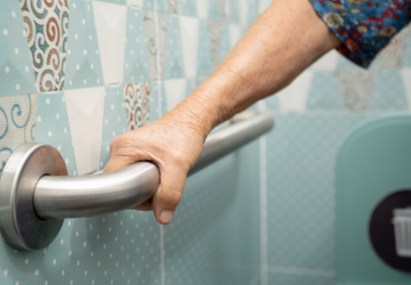
There’s an unusual sort of reluctance to fit grab rails in bathrooms. Lots of people fear that they will send some sort of signal about the age or stage of life of its occupant and that he or she needs a bit more assistance with trips to the loo. Most grab rails are put up after someone has already been seriously hurt or injured in the bathroom. Once they’ve been fitted, people seem to realize that they are perfectly acceptable and that there is nothing odd at all about having a grab rail in a bathroom – exactly as there is nothing at all unusual about a handrail on a staircase.
These items can be installed so as to be easily retrievable (i.e. as a healthy person would use them). For toilet grab rails, look for models with adjustable height settings. These can be set to a suitable height for a healthy individual to use. Typically this would be at the lower part of the toilet frame. If installed at head height, they are pretty useless.
The placement of grab rails is important as well. A grab rail that is mounted too high or too far from where weight transfer is taking place will be of little use. In general, a shower grab rail should be mounted at a height where your hand naturally falls when entering or turning around in the shower. A toilet grab rail should be mounted at an angle to provide assistance when lowering and standing up from the toilet.
Step 6: Lighting.
Dim bathrooms are the worst! Small windows and usually one overhead light, which is typically a warm colored and low wattage light, designed to make the bathroom look nice in a magazine. But, let’s be real, most bathroom use occurs in the half light of morning, after a long sleep and half awake. So, if you are unlucky enough to have a tumble in the bathroom, it can be a real disaster.
On the other hand, there are many bathroom solutions, that will cost nothing. A night light in the bathroom can prevent many slips and falls. Such non intrusive lights are cheap to buy and are a good idea for bathrooms with limited space. Also, for old people and children, a well lit up bathroom is easier to move around and will help prevent many accidents and injuries. As with all things, the most cost effective solution is the best one.
Seating support changes everything for daily routines
A great deal of help in the bathroom can be offered by having a bathroom stool in the shower. This is particularly the case for people who have problems standing for long periods of time in the shower. Such problems can be as a result of post-surgery recovery, chronic fatigue, an imbalance problem or old age. The type of bathroom stool that is of most use is a high quality model that has an adjustable height. This means that the stool can be set to any height that is required and it will also be strong enough to hold the user’s weight. The great compactness of these stools when not in use makes them ideal for storing in a corner of the shower.
There are many different types and styles of shower stools that are available to purchase on the market today. A compact recovery stool is the perfect addition to a small shower or one that is only occasionally used. They are available in a range of styles and come in a variety of different sizes. Many of the compact recovery stools available have an adjustable height, which will allow you to change the height of the seat as required. This will mean that you can use the stool for as long as you need to, and the seat will be at a comfortable height for you. Having a good quality recovery stool in your bathroom can be a lifesaver and will make a huge difference to anyone that uses the shower.
(Shower stools are also very useful for people who need a seat for other reasons for periods of time such as people shaving their legs, washing their feet etc. ie. They can provide a very stable and secure seat for such people on one foot).
See also: The Benefits of Artificial Intelligence in Business Forecasting
Rethinking layout accessibility
Sometimes the upgrade isn’t a product at all.
| Layout issue | Common mistake | Better approach |
| Shower entry | High step-over threshold | Low or zero-threshold entry |
| Toilet clearance | Tight walls on both sides | At least one open side for support access |
| Storage placement | Shelves requiring reaching or bending | Mid-height shelving within easy arm reach |
| Door swing | Inward-opening door in tight spaces | Outward swing or sliding door |
Most of these environmental changes can be completed within a very small budget and need not involve the complete overhaul of a bathroom to achieve the necessary changes. In the main, simple re-arrangements of products already within the bathroom and simple swap of components already within a curtain or pole system are all that is required. There are many examples: re-positioning of a floor length shower curtain for better access; re-positioning of a double brack curtain pole for better support of grab rails; re-positioning of toilet tissues and soap dispensers for better reach. Many accidents within a bathroom are down to the environment not the individual. So changing the environment to ensure the individual’s best safety is paramount.
My neighbor who is 62 years young recently made some simple changes to her bathroom and installed 2 grab rails and a motion light. She said it took her about 2 hours on a Saturday afternoon to set up. At first it looked a little strange but now she never even notices them.
Start small. One mat. One rail. One light.