ByJohn A
How Does TITUM Fusion Double Impact Nonstick Technology Prevent Warping?
Cookware performance is strongly influenced by how well it handles heat stress, repeated temperature changes, and long cooking cycles. One of the most common structural issues in pans is warping, which directly affects heat distribution, stability, and cooking precision.
Modern cookware engineering focuses on solving this problem through layered construction and heat-responsive material design. Premium systems such as those developed under Hestan Culinary prioritize structural integrity along with cooking performance, ensuring that cookware remains stable even under frequent heat exposure. This balance between durability and thermal control is essential for consistent long-term use.
Why Cookware Warps in the First Place
Warping is not random. It is the result of predictable physical reactions that occur when metal is exposed to uneven or repeated heat stress.
Uneven thermal expansion in thin metals
Metals expand when heated, but they do not always expand evenly. In thinner cookware, some sections heat faster than others, causing uneven expansion across the surface.
This imbalance creates internal tension, and over time, the base begins to bend or distort. Once the structure loses flatness, cooking performance becomes inconsistent due to poor surface contact.
See also: Why Perfume Samples Are Essential for Fragrance Testing
High heat exposure and structural stress
Repeated exposure to high temperatures increases stress cycles within cookware materials. Each heating and cooling phase causes expansion and contraction, which gradually weakens structural alignment.
Without reinforcement, this repeated stress eventually leads to permanent deformation and reduced cooking efficiency.
Material limitations in low-cost nonstick pans
Lower-cost cookware often uses thin or single-layer metals that are not designed for long-term thermal stability. These materials lack the structural depth required to manage heat stress effectively.
As a result, they tend to warp more easily, especially when exposed to frequent or high-temperature cooking conditions.
What Is Double Impact Nonstick Technology?
Double impact nonstick technology is designed to improve cookware stability by combining multiple layers of metal that work together to resist heat deformation and improve structural balance.
Layered stainless steel base design
A key component of this system is the stainless steel base, which provides rigidity and structural support. Stainless steel helps maintain shape integrity even when exposed to repeated heating cycles.
This ensures the cookware remains stable and flat across a wide range of cooking temperatures.
Aluminum core heat responsiveness
Inside the layered structure, aluminum acts as a heat-responsive core. It distributes heat quickly and evenly across the surface, reducing localized overheating.
This fast heat conduction helps minimize uneven expansion, which is one of the primary causes of warping.
Structural reinforcement under pressure
The combination of stainless steel and aluminum creates a reinforced base that distributes both heat and physical stress evenly.
This reduces pressure concentration points and improves resistance to bending, especially during frequent or high-intensity cooking use.
How TITUM Fusion Solves Heat Instability
Heat instability is one of the biggest contributors to cookware deformation. Advanced structural design focuses on controlling how heat moves through the pan.
Even heat flow across the cooking surface
A stable heat flow ensures that all parts of the pan expand at a similar rate. This reduces internal stress caused by uneven temperature zones.
Even heat distribution also improves cooking accuracy by maintaining consistent surface temperature during use.
Reduced deformation during rapid heating cycles
Rapid heating and cooling can place sudden stress on cookware. Reinforced construction helps absorb this thermal shock by distributing energy more evenly across the base.
This reduces the risk of sudden bending or structural distortion during fast temperature changes.
Stability on induction and gas cooktops
Different cooktops apply heat in different ways. Induction systems require a perfectly flat base for magnetic efficiency, while gas cooktops expose cookware to direct flame heat.
A reinforced structure ensures stable performance across both types without losing alignment or surface balance.
TITUM Fusion double impact nonstick
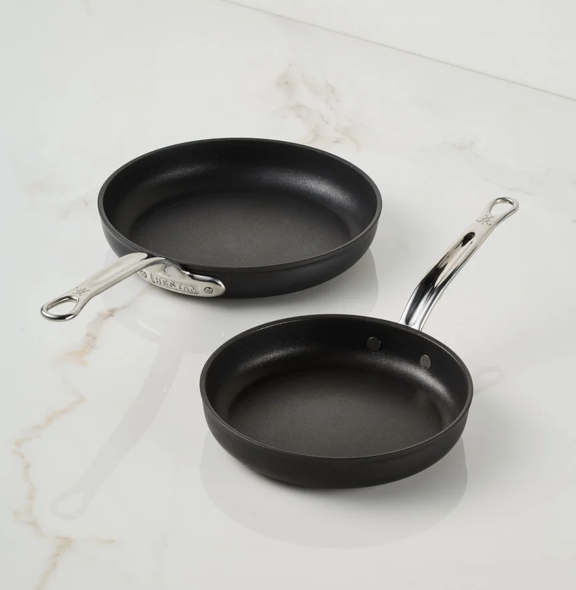
The TITUM Fusion double impact nonstick system is engineered to combine heat responsiveness with structural reinforcement. Its layered construction is designed to reduce warping risk by balancing thermal expansion across multiple metal layers.
The aluminum core ensures fast and even heat transfer, while stainless steel reinforcement maintains structural rigidity. This combination helps stabilize the cookware during repeated heating cycles, reducing long-term deformation.
From a performance standpoint, this results in improved heat control, better surface stability, and more consistent cooking outcomes over extended use.
Performance Benefits in Real Cooking Conditions
Structural stability directly influences cooking performance, especially in terms of heat control and surface behavior.
Consistent browning and searing control
Even heat distribution allows food to brown uniformly across the surface. This improves control over searing intensity and reduces uneven cooking zones.
Stable heat behavior also makes it easier to maintain predictable cooking results without constant adjustments.
Better oil distribution and food contact
A flat and stable surface ensures that oil spreads evenly across the pan. This improves contact between food and the cooking surface, resulting in more consistent cooking.
Uneven bases can cause pooling, which disrupts heat transfer and reduces cooking efficiency.
Reduced wear on nonstick coating
When cookware maintains structural stability, the nonstick coating is subjected to less mechanical and thermal stress. This helps reduce premature wear.
It also supports longer coating performance and more reliable food release over time.
Engineering Perspective on Long-Term Durability
Durability depends on both surface quality and internal structure. Without structural strength, even advanced coatings cannot perform effectively.
Why structural stability matters more than coating alone
A nonstick coating is only as effective as the surface it is applied to. If the base warps, heat distribution becomes uneven, and the coating experiences uneven stress.
Structural reinforcement ensures that the coating remains stable and performs consistently throughout its lifespan.
Comparison with conventional nonstick systems
Traditional nonstick pans often rely on thinner bases that prioritize cost over durability. These designs are more vulnerable to heat-induced warping.
In contrast, double impact systems use layered reinforcement to maintain shape stability and improve long-term thermal performance.
Maintenance considerations
Proper usage plays an important role in preserving cookware performance. Using moderate heat settings helps reduce thermal stress.
Avoiding sudden temperature shifts also helps maintain structural integrity over time. Gentle cleaning practices further protect the surface and internal layers.
Key engineering highlights
- Multi-layer construction improves structural strength
- Aluminum core enhances heat responsiveness
- Stainless steel layer prevents deformation
- Even heat distribution reduces warping risk
- Compatible with induction and gas cooktops
FAQs
1. Why does cookware warp over time?
Warping occurs due to uneven thermal expansion when different parts of the pan heat at different rates during repeated use.
2. How does double impact technology reduce warping?
It uses layered metal construction to distribute heat and stress evenly, reducing structural imbalance.
3. What role does aluminum play in heat stability?
Aluminum improves heat conduction, ensuring faster and more even temperature distribution across the surface.
4. Can rapid heating damage cookware structure?
Yes, repeated rapid heating can create thermal stress, but reinforced construction reduces this risk significantly.
5. Does a stable base improve cooking performance?
Yes, a flat and stable base ensures better heat contact, more consistent cooking, and improved coating durability.
Conclusion
Cookware warping is primarily caused by uneven heat distribution, material limitations, and repeated thermal stress. Advanced engineering solutions focus on solving these issues through layered construction and balanced heat management.
The TITUM Fusion double impact nonstick system demonstrates how structural reinforcement and thermal responsiveness work together to improve stability, reduce deformation, and enhance long-term cooking performance. By addressing both heat flow and material strength, it provides a more consistent and reliable cookware experience.